

Classroom Set Up
Classroom Rational for Design
-
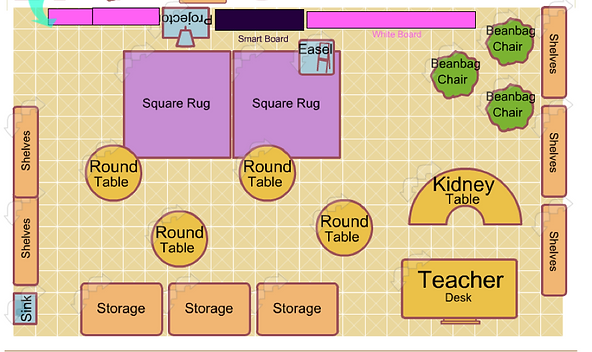
The Arrangement of the Classroom will be made up of four Group Tables with 5-6 students at each table. These group tables will be called “Family Tables” and they will be where students learn during group instruction, perform group work, and do independent work. Tables will be made up of students of mixed ability, diverse backgrounds, cultures, race, genders, and sexual orientation. The students will choose a “Family Table Name” at the beginning of the year that their Family Table will be referred to for the rest of the year. The students will make a sign that will be hung above their Group Family Tables for reference and to build community among Family Tables.
-
A Rug with Assigned Seating Circles will sit at the front of the room. The students will have assigned seating and a circle will be designated to each student. The carpet will be used for morning meetings, whole group discussions, read-alouds, and more. An easel will be placed near the carpet, at the front of the classroom, for reviewing information, examples, and for guided notes.
-
Personalized Learning is used in my classroom and individualized IPad will be provided for each student and the Charging Station will be placed on the storage cabinets in the back of the classroom. Individual IPads will remain sit in the charging station, until students are instructed to retrieve them table by table for various independent and group work. They will be returned to the charging station in the same fashion, and in the rare event that the teacher is teaching with the iPads, students will be asked to stack them in the center of their group table face down while they are listening to direct instruction. A Technology Pledge (that includes IPads) will be signed at the beginning of the year with student signatures, after reviewing the rules of conduct regarding technology. The teacher will also be provided will an Individual I-Pad and will use it for communicating with parents, recording
-
A Differentiated and Non-Differentiated Library composed of multiple bookshelves will sit in the left corner of the classroom. A Reading Nook comprised of three bean bag chairs and draped with fire retardant string lights will be draped over bookshelves and be hung throughout the classroom. The library will be placed on two shelves and comprised of book boxes with Leveled Reading labeled by difficulty, leveled by Fountas & Pinnell, A through Z. A third bookshelf will be used for books that are not identified by reading levels and will be labeled by Subject or Content, Read-alouds for teacher and student use, as well as for Non-Student use Textbooks, Dictionaries, Thesauruses and Other Literary Resources.
-
Artificial and Natural Lighting will be present in the classroom. The Windows will provide natural light, and will cover the upper half of the wall on the right side of the classroom. The windows will have drapery curtains hung over the top of each side, and will remain open besides special circumstances. The curtains will only be closed for watching video on the Smartboard, for Meditations, and teacher determined times when the class needs calming, like following recess, conflict, or for class read-alouds or audiobooks. Artificial Lighting will line the ceiling and will be used flexibly and interchangeably with 7 Lamps (placed next to the Easel/ Projector, Teachers Desk, and on five of the shelves) as well as the String Lighting.
-
In Arts with the Brain in Mind, Eric Jensen states “Many experts think children suffer from poor illumination at school. A large study from the Heschong Mahone Consulting Group in Sacramento, California, verified this-and caught the eye of the popular press…. Students in the brightest classrooms (better skylights and more natural lighting) scored 20-25 percent higher on reading and math scores than did students in the poorly lit classrooms,” (Jensen, 2001, p. 98.)
-
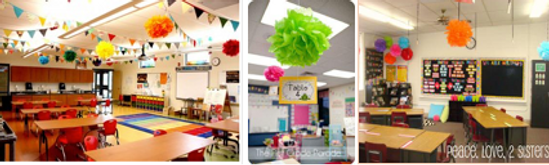
The classroom will be clean, organized, and uncluttered, yet remain colorful, creative, unique, and representative of the students and what is being learned and décor will center on the idea of “A Classroom Garden” in an effort to keep students connected to nature and the classroom will house Multiple Plants. These plants will include Peace Lilies, Lady Palms, Areca Palm, Ficus Allii, and each will provide air purification and beauty. Each week, a student will be chosen on the Job Chart to water specific plants on Mondays, Wednesdays, and Fridays.
-
The Front of the Classroom will be comprised of Two Sliding Whiteboards and a SMART Board. The First White Board will display the classroom contract, Schedule for the day with Magnets for Easy Alteration, have Movable Clips that will hold the Standards being covered each week, a Dry Erase Classroom Calendar with Student’s Birthdays written in as well as Important Class and School Events, a Classroom Jobs Chart, the Homework Assignments for that Night, Reminders for the Week, and the Noise Meter.
-
The Second Whiteboard will be used for teaching and display the Classroom Rules and Consequences.
-
In between the SMART Board and White Boards will lie a Teachers Cubby that holds a Projector, a connector for the teacher’s laptop to the Smart Board, the classroom sound system, and extra storage. The Teacher’s Laptop and IPad will be moved between his/her desk and the Teacher’s Cubby throughout the day.
-
Underneath the SMART Board and behind the Sliding Whiteboards will lie Storage Space. The Storage Space under the SMART Board will be used to store manipulatives and models where they are visible and easily accessible.
-
The Teacher’s Desk will sit at the back of the room so the teacher has a view of all four tables.
-
A Kidney Bean Table will sit in front of the teacher’s desk and will be used during individual work, small groups, group work, and for struggling students in need of more scaffolding, students with disabilities (including learning disabilities,) as well as students that are easily distracted or frustrated, and as a behavior consequence for students that don’t abide by the Classroom Rules. The Kidney Bean Table will also be used for teaching, working with, or assessing specific groups during reading, writing, and math.
-
The Entire Wall Behind the Teacher's Desk will be a Storage Space. The area directly behind the Teacher's Desk will be specifically designated for teacher use only. The Other Storage space will be used for Classroom Supplies, Resources, Material, Student Mailboxes, Student Hanging Space and IPad and Textbook Storage and more.
-
The Teacher's Storage Space will store teaching resources, lesson plans, pencil sharpener, and materials like unsharpened pencils, erasers, paper towels, soap, hand sanitizer, scissors, rulers, tissues, classroom decorations, etc.
-
The Other Space for Storage will hold the charging station for Student IPads, the Sharp and Dull Pencil Buckets, Textbook Storage Shelves, the “Turn It In Bin”, a “No Name Claim Station”, and Family Table Bins with supplies like scissors, glue, and markers. There will also be hanging space for students backpacks and jackets here, as well as space for special art supplies boxes for each table like crayons, paints, pastels, and colored pencils.
-
A Drawer Stack will be used by the teacher with each day of the week labeled by day. Lesson plans, papers, worksheets, quizzes, tests, handouts, will be placed in this organizer on each Friday for each day of the following week according to the Long-Range Plan. If that requires copies to be made, papers to be printed, or material to be collected it will be done the day before the lesson is taught by the teacher before he/she leaves the school. There will also be a “Turn It In Bin” Drawer Stack labeled with the weekdays in the student storage locker where students will turn in their work by placing it in the corresponding day.
-
The “Class Community Corner” will be a space dedicated solely to displaying Photographs of the Class and Individual Students, Class Achievements and Projects, Student Artwork, A-Mazing Classwork and Homework, and Individual Student Achievements, Awards, and Photographs from in and outside of school.
-
Half of the left Wall in the Classroom will be completely Covered in Cork Board and be designated as the “Class Community Corner.”
-
For the First Month of school, the “Class Community Corner” will hold the student’s Photograph, “Get to Know Me” Activities, and their page from the “All About Us!” Book they create for the Classroom.
-
The “Class Community Corner” will be changed out each month to ensure their content stays new and relevant. The teacher will begin taking down the “Class Community Corner” each month with the help of students during Independent Practice.
-
The teacher will choose students that have completed their work or who have demonstrated respectful behavior for the day to help take him/her begin to take down the old material and redecorate the cork board with new material.
-
The “Class Community Corner” will be a sharing space for the classroom community. The goal of the “Class Community Corner” is to build classroom confidence, community, and an environment that celebrates the success of others.





MORE ON TECHNOLOGY IN THE CLASSROOM
-
The SMART Board, Teachers Laptop and IPad, High-Tech Sound System, White Boards, Individual Student IPad’s with corresponding Headphones, Telephone/Radio to communicate with administrators and various other school personnel, and guardians will be the main means of technology in the classroom.
-
The SMART Board and White Boards will be used for lessons, presentations, to show videos, music and more.
-
Individual Student IPads will be used by students for assessments, skill practice, group work, reading, and to create videos, audio recordings, word webs, to access appropriate internet content, to view educational websites like National Geographic Kids, YouTube, Online Dictionaries and more.
-
I-Pads will also be used to access Apps like Kahoot, Popplet, Reflex Math, Multiplication Flashcards, and more.
-
Specific Apps will provide accommodations and modifications to student with disabilities to assist them in reading, writing, altering texts, books, and articles, as well as highlighting and adding notes.
-
I-Pads will also be used to create art projects, visual displays, compile reports, photograph collages and more on specific content areas like social studies and more, and most often they will be used for differentiated learning.
-
Students with 504, IEP’s, learning disabilities, gifted and talented, struggling students, etc. will often use specific apps or functions to monitor progress, practice specific skills, for more or less challenging content, for communication, the calendar function to repeat, remind, and remember specific tasks, events, and assignments. They will also use I-pads and Apps to practice social skills, organization skill, emotional regulation, to